How to find used parts at a junkyard
The part you need is often sitting in a yard right now, on a car you would never think to check. Here is how to narrow the search before you go and judge the part once you find it.
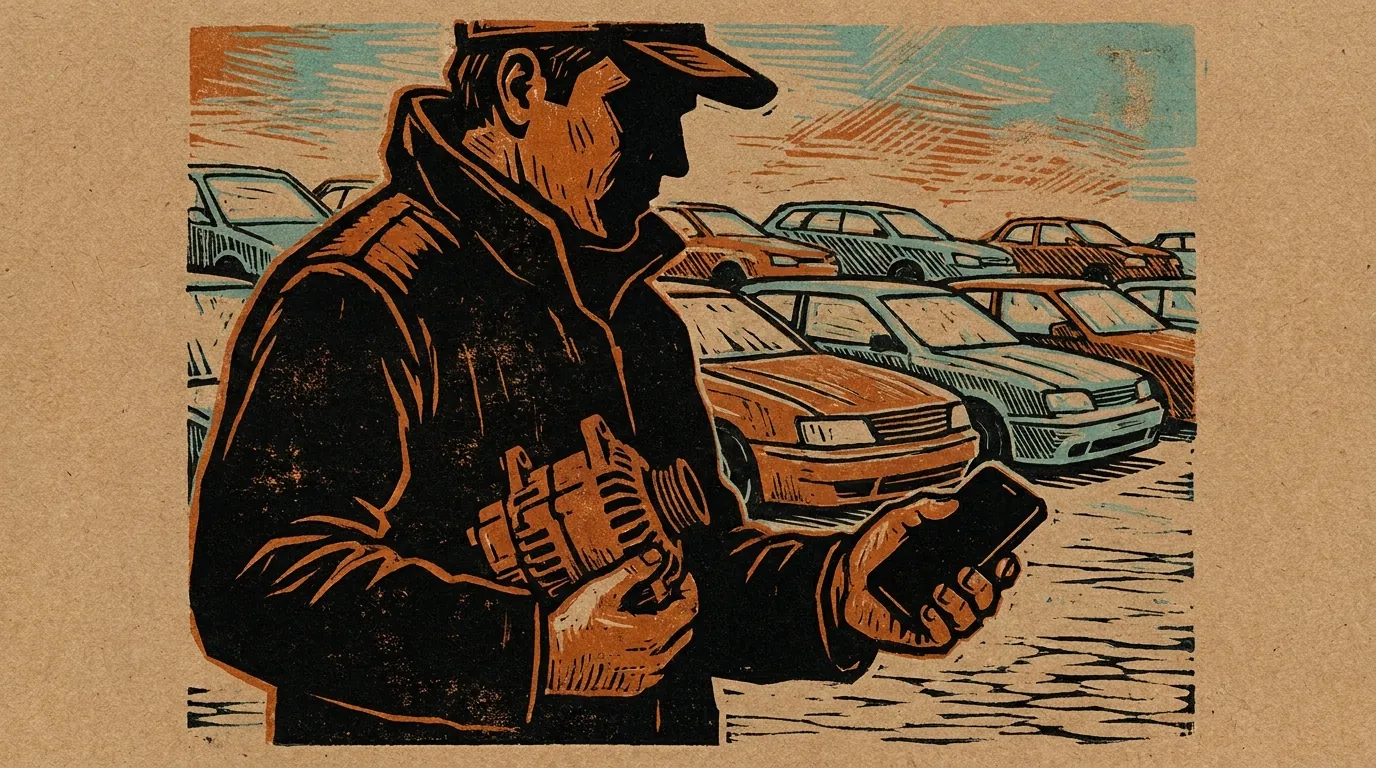
A junkyard search goes faster when you know three things: exactly what part you need, which other vehicles use the same part, and which yards near you have those vehicles. The first two you can do at home. The third takes an online search or a few phone calls.
Start with the exact part
Write down your car's year, make, model, trim and engine size. Many parts change with the trim or the engine, even in the same model year. A V6 and a four-cylinder version of the same car can use different alternators, radiators and axles. Your VIN (on the dashboard by the windshield and on your registration) pins down the details if you're not sure.
Then look for a part number. Many parts have one stamped, cast or printed on a label: alternators, starters, sensors, control modules, headlights, mirrors and many body parts. Take a clear photo of it. If you can't find one on the old part, a parts store or the dealer's parts counter can often look it up from your VIN.
Take photos of the part on your car from a few angles, including the connectors and mounting points. You will compare them against the part in the yard.
Interchange: the same part on other cars
Carmakers reuse parts. The same alternator might go on several model years of one car, on a sister model sold under another brand, or on a truck and an SUV built on the same platform. In the parts trade this is called interchange: the list of vehicles that share a part.
Interchange matters at a junkyard because it multiplies your chances. If your exact model isn't in the yard, a car that shares the part might be. A few ways to use it:
- Match part numbers. If the number on a part in the yard matches yours, it is the same part. Some numbers change with a small revision and still fit; a parts counter can tell you.
- Ask the yard. Many full-service yards, and some self-service yards, have interchange lists at the counter and can tell you which cars to look at.
- Search online. Owners' forums and parts sellers' sites often list which years and models share a part.
- Compare in person. Same shape, same connectors, same bolt holes. When a model is redesigned, parts often stop interchanging, so watch for the year a body style changed.
Be careful with parts that are programmed to one car, like some engine computers, keys and radios. They may need to be reprogrammed by a dealer or a shop before they work in another car.
Check online inventory
Many yards post the vehicles they have on their website, often with the date each car arrived and the row it sits in. In this directory, 1,772 listed yards have a customer review or website that mentions online inventory, 452 of them pull-your-own yards. Others may post one too, so check the yard's website.
Read an inventory list for what it is. At most self-service yards it shows vehicles, not parts. A car listed as being in row 12 may already be missing the part you want, because someone else pulled it yesterday. New arrivals have the most parts still on them. Full-service yards are more likely to list individual parts they have already pulled and tested.
Call ahead
A two-minute call can save a long drive. Ask:
- Do you have a car that matches mine (or one from my interchange list)?
- Is the part still on it, as far as you know?
- Do you pull parts for customers, or do I pull it myself?
- Can you hold the part for me, and for how long?
- Is there a core charge, and what is your return or exchange policy?
At a full-service yard the counter can often check the actual part and tell you its condition. At a pull-your-own yard staff may only know which cars are in the rows.
Some yards specialize. The directory lists 527 trucks yards, 276 motorcycles yards, 260 imports yards, 194 RVs and campers yards, 101 heavy equipment yards and 57 boats yards, counted from the yard's name, customer reviews or its website. See all specialty yards.
Check the part for wear
A used part is only a bargain if it works. Before you pull it, or before you pay, look it over:
- Anything that spins (alternators, power steering pumps, idler pulleys): turn it by hand. It should move smoothly with no grinding, roughness or side-to-side play.
- Anything that holds fluid (radiators, condensers, calipers): look for cracks, wet spots, crusty residue and bent fins.
- Electrical parts: check connectors for green corrosion and broken locking tabs. Look for burned or melted plastic.
- Lights and glass: check the mounting tabs, which break easily, and look for haze, cracks and water inside the lens.
- Body panels: look at the back side for rust and old repairs. Bring a magnet; it won't stick well over thick body filler.
- Axles: torn rubber boots let dirt into the joint. Look for grease thrown around the inside of the wheel.
- Engines and transmissions: note the odometer reading of the donor car if you can read it. Check the oil and transmission fluid for color and smell. A full-service yard may have tested the unit; ask what testing was done and what warranty comes with it.
Know the return policy before you pay. Some yards exchange a part that doesn't work, some give store credit, and some sell everything as-is.
What customers say
Sentences from 4 and 5 star Google reviews of listed yards:
“One of my favorite features is their online inventory, which is updated regularly so you can check if the vehicle you need is in the yard before making the trip.”
“Last time I went there after double checking online inventory, and they had just moved the row I needed to get crushed.”
“The staff were knowledgeable and helped me find exactly what I needed quickly.”
Pull it yourself or have it pulled?
Of the 5,296 listed yards, 734 are shown to let you pull your own parts and 1,050 to pull parts for you. Pulling it yourself costs less and lets you inspect the donor car. Having it pulled saves time and tools, and often comes with a tested part and a warranty. Read full-service vs self-service junkyards to decide, and what to bring if you're doing it yourself.
Quick answers
- How do I search for a part at a junkyard?
- Start with your exact year, make, model, engine and trim, and the part number from your old part if you can read it. Check which other models and years use the same part, then look at the yard's online inventory or call and ask whether they have matching cars.
- What does interchange mean for car parts?
- Interchange means the same part fits more than one vehicle. Carmakers reuse parts across model years and across related models, so a part from a different car can be the exact same piece. Matching part numbers, connectors and mounting points confirm it.
- Does a junkyard's online inventory show parts?
- Usually it shows which vehicles are in the yard, not which parts are still on them. A part may already be pulled or damaged, so call ahead before a long drive.
- How do I check a used part for wear?
- Look for cracks, leaks, corrosion, broken tabs and missing hardware. Spin anything that turns, like an alternator pulley, and feel for grinding or play. Check the odometer of the donor car if it is readable, and ask about the yard's return policy before you pay.
General information, not legal or safety advice. Yard rules, title and paperwork rules vary by yard and by state, so ask the yard and check with your state's DMV. We don't quote prices or payouts: what a yard charges for parts or pays for a car changes daily.